
RAG vs AI Agents vs Agentic AI: What's the Difference?
RAG vs AI Agents vs Agentic AI: What's the Difference?
Spend an hour reading vendor pages and LinkedIn posts on this topic and you'll see RAG, "AI Agent," and "agentic AI" used almost interchangeably — sometimes in the same paragraph, to describe three genuinely different pieces of engineering. Part of the problem is incentive: it is easier to sell something as "agentic" than to explain that it's really a chatbot with a search plugin bolted on. Gartner has a name for this pattern — "agent washing" — and estimates that of the thousands of vendors currently claiming agentic capabilities, only a small fraction offer the real thing (more on that with numbers further down).
That level of inaccuracy isn't harmless. It leads teams to buy the wrong tool, budget for the wrong level of complexity, and get blindsided by governance risks they didn't know they were signing up for. So, in this article, we explain what each term actually means and how they differ from one another.
RAG vs AI Agents vs Agentic AI: Understanding The Terms
You can think of a research team writing a report.
- RAG is a librarian who fetches the right books and hands you relevant pages before you write.
- An AI Agent is one researcher who can also use tools — search the web, run a calculation, send an email — to complete one clearly defined task you gave them.
- Agentic AI is the whole research team, coordinated by a lead, that plans the report from scratch, decides what needs researching, assigns sub-tasks, checks its own work, and adapts the plan when something doesn't pan out — with minimal check-ins with you.
In technical terms: RAG is a data-grounding technique. An AI Agent is a single autonomous unit that uses tools to complete a task. Agentic AI is a system-level design — often multiple agents working in a loop — built for open-ended, multi-step goals with limited human supervision. IBM frames it this way: an agentic setup is essentially a network of narrower, LLM-based decision-makers, with one "conductor" model overseeing the others and dividing the work between them.
1. RAG (Retrieval-Augmented Generation): the fact-checker
RAG isn't an agent or a product — it's a technique. The term was coined in a 2020 research paper, and its lead author has since joked that the team never expected the slightly awkward acronym to become an industry standard. What it does is simple: instead of trusting an LLM's memory alone, RAG connects an external data source to the model so it can generate domain-specific, up-to-date responses in real time rather than relying purely on what it learned during training.
How it actually works
- You ask a question.
- The system converts your query into a vector and searches a database (usually a vector database) for the closest-matching chunks of text.
- Those chunks get inserted into the model's prompt as context.
- The model writes an answer grounded in that retrieved text — ideally with citations.
Why it exists: LLMs hallucinate when they don't know something and answer anyway. NVIDIA describes RAG plainly as a technique for enhancing the accuracy and reliability of generative AI models with information fetched from specific and relevant data sources — the same logic as a court clerk pulling the exact precedent a judge needs instead of the judge answering from memory.
Where you'll already recognize this: Any workflow that forces a writer or a model to quote only from an official PDF or primary source — instead of relying on memory — is applying RAG's core logic even without calling it that. That's the whole value proposition: don't let anyone, human or model, improvise on facts that are checkable against a source.
Where RAG stops: It's a single-shot pipeline. It retrieves, then answers. It doesn't decide to double-check itself, doesn't call an API to actually do anything, and if the retrieval step pulls weak or irrelevant documents, the model will confidently summarize garbage without realizing it should have searched again.
2. AI Agents: the tool-using worker
An AI Agent takes RAG's "look things up" ability and adds "take an action." IBM's working definition is straightforward: it's a system that plans its own workflow, choosing which of its available tools to use and when, based on what the user's input requires.
How it actually works
Instead of only generating text, the model is given a defined set of "tools" — a web search function, a calculator, a calendar API, a database write — and it outputs structured calls like send_email() or get_stock_price("RELIANCE"). This mechanism is called function calling or tool use, and it's the technical backbone of everything from customer-support bots to coding assistants.
An AI agent is a computational entity that perceives its environment, reasons about what it observes, and executes actions toward an explicit goal with limited human intervention — but it does this for one bounded task at a time. It's not out there setting its own objectives.
Consider an example: a trading-signal scanner that pulls live market data, scores momentum shifts against a fixed rule set, and fires an alert is a textbook single agent — it does one job well: detect and notify. It doesn't decide, on its own, to also rebalance a portfolio or place a trade. That's the defining boundary of an agent versus an agentic system: it stays inside the lane it was built for.
Where AI Agents stop: They're mostly reactive to an immediate instruction or a narrow, repeatable trigger. They don't usually manage a long-running, ambiguous business goal that spans days and multiple systems — that's the next layer up.
3. Agentic AI: the autonomous system
Agentic AI is where the "agency" really shows up — the capacity to act independently and purposefully toward a goal, not just respond to one instruction. In IBM's framing, it's a network of narrow, LLM-powered decision-makers working under limited human oversight, with a lead "conductor" model dividing the larger goal into pieces and assigning them out.
How it actually works
Agentic AI runs a continuous loop — plan, act, observe the result, adjust the plan — instead of a single request-response pass. If a tool fails, a data source changes, or a constraint shifts mid-task, the system is designed to notice, revise its own plan, and try a different route without asking you first. MIT Sloan frames the shift plainly: agentic systems are a new class of AI that is semi- or fully autonomous and able to perceive, reason, and act on their own — a meaningful step beyond the now-familiar chatbot that just answers questions.
A generative AI model can tell you the best time of year to climb Mt. Everest. An agentic AI system can take that answer and go book your flight and hotel around it — without you doing the booking yourself.
Consider an example: a market-intelligence system where a data-pull sub-agent, a sentiment-scoring sub-agent, and a risk-assessment sub-agent hand work to each other and continuously revise their combined output as new data streams in — rather than one script running once and stopping — is the "corporate team" structure researchers keep pointing to when they describe genuinely agentic systems.
Please note: Not every "multi-step" system deserves the agentic label. Analysts at Domino Data Lab warn that flattening agentic AI into "RAG plus workflow orchestration" is a convenient but inaccurate description — real agentic systems are defined by their capacity to pursue goals and adapt based on outcomes, not just by chaining more steps together. This is exactly the "agent washing" problem Gartner has flagged in the market.
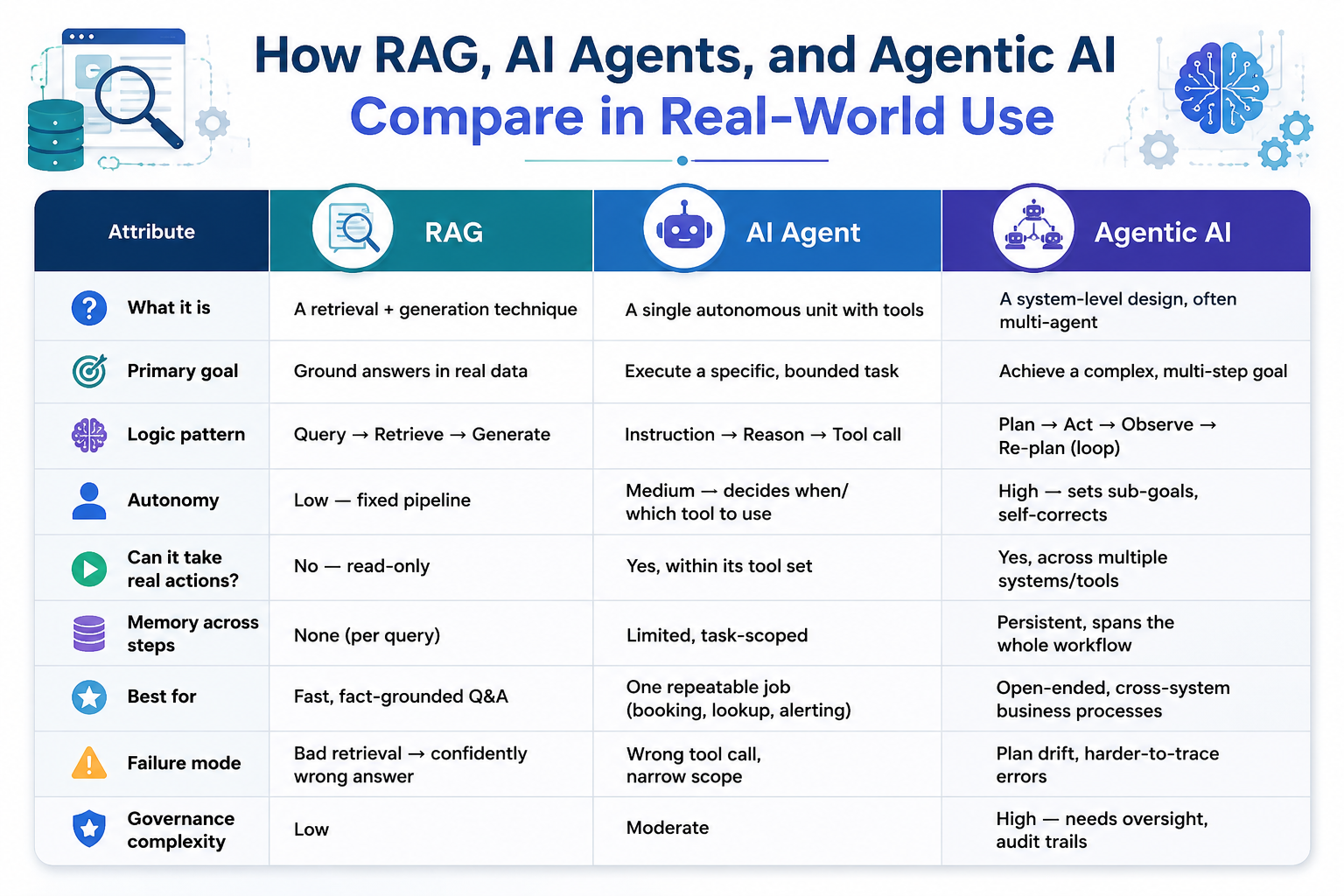
How RAG, AI Agents, and Agentic AI Compare in Real-World
Below table highlights major differences between RAG, AI Agents, and Agentic AI:
What the data actually shows (not just the hype)
Because this space moves fast and gets over-marketed, the numbers matter more than the adjectives.
Adoption is real but early. A McKinsey survey cited by security researchers found that 23% of organizations were already actively scaling agentic AI across at least one business function, with another 39% still in experimental deployment — meaning most companies experimenting with this today are nowhere near full production.
A lot of what's marketed as "agentic" isn't. Gartner's own analysts have coined the term "agent washing" for vendors rebranding ordinary chatbots and automation tools as agentic AI. Gartner projects that over 40% of agentic AI projects will be canceled by the end of 2027, citing escalating costs, unclear business value, and inadequate risk controls — while still forecasting that 33% of enterprise software will include real agentic capabilities by 2028, up from under 1% in 2024.
"Most agentic AI projects right now are early stage experiments or proof of concepts that are mostly driven by hype and are often misapplied." — Anushree Verma, Senior Director Analyst, Gartner
Read more: What is Multimodal AI? How Text, Audio, and Images Work Together
Where they merge: Agentic RAG
In real production systems, these three aren't rivals — they stack. Agentic RAG is what you get when an autonomous agent treats retrieval as just one tool among several, rather than a fixed one-shot pipeline. NVIDIA's applied engineering team puts it simply: unlike a fixed retrieval pass, agentic RAG lets the surrounding system weigh its options, adjust course as requirements shift, and work through harder reasoning problems on the fly.
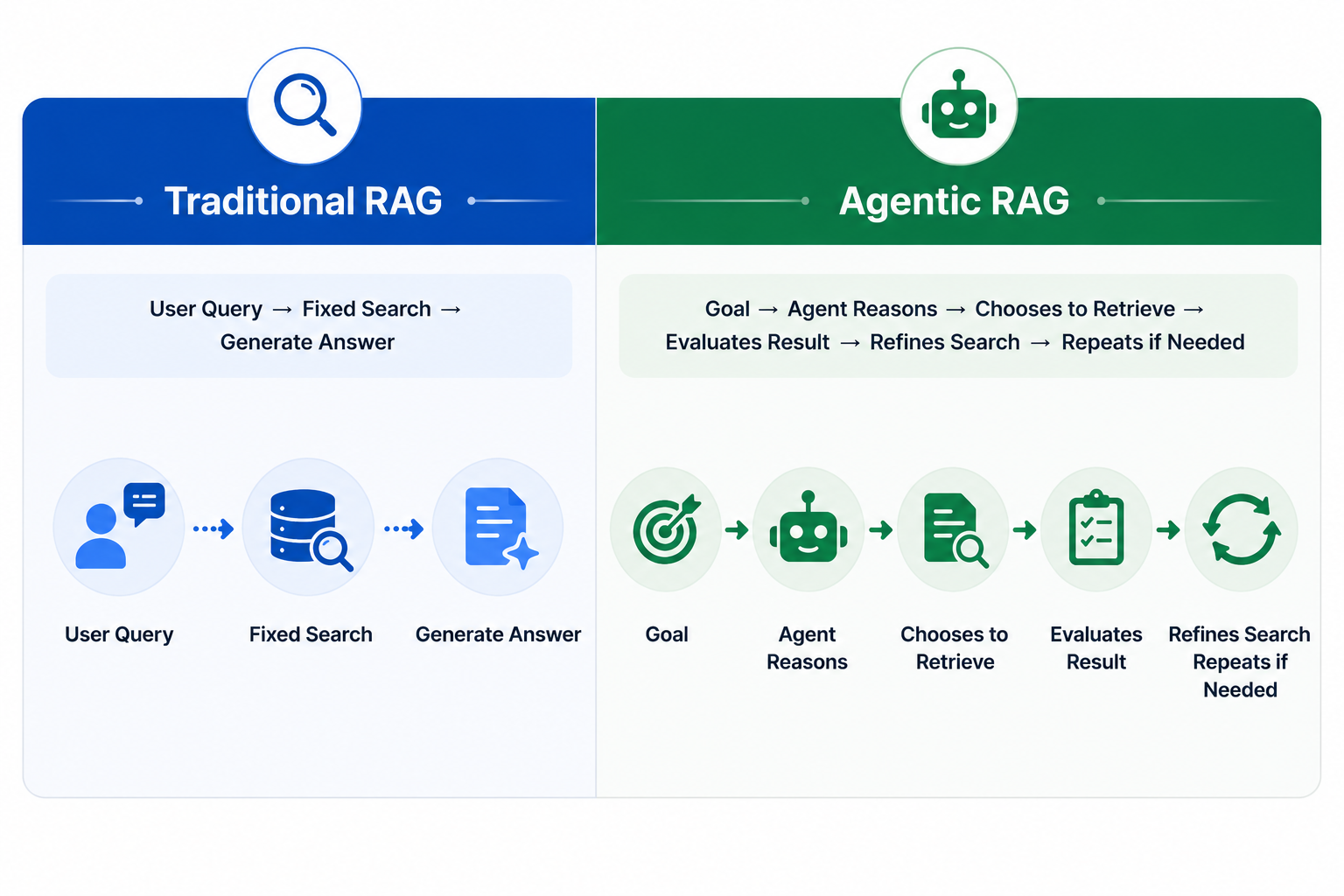
Practically, this is where most serious enterprise deployments are heading — you keep RAG's fact-grounding discipline but let an agent decide when to search, whether the results are good enough, and what to do next if they aren't.
Case in point: Security researchers studying agentic RAG deployments point out that an agent running its own observe-orient-decide-act loop isn't limited to answering — it can actually execute steps across connected systems: firing off an email, writing to a database, editing a file, or triggering a chain of downstream actions that no single person explicitly signed off on. That's genuinely useful, but it's also exactly why access controls and permissioning matter far more here than in plain RAG, where the model can only ever read, never write.
Read more: Edge AI vs Cloud AI: The Future of Local Machine Learning
Which one do you actually need?
Based on how Gartner, IBM, and enterprise architecture teams frame the decision, here's a simple way to match the problem to the right layer before committing budget to a build:
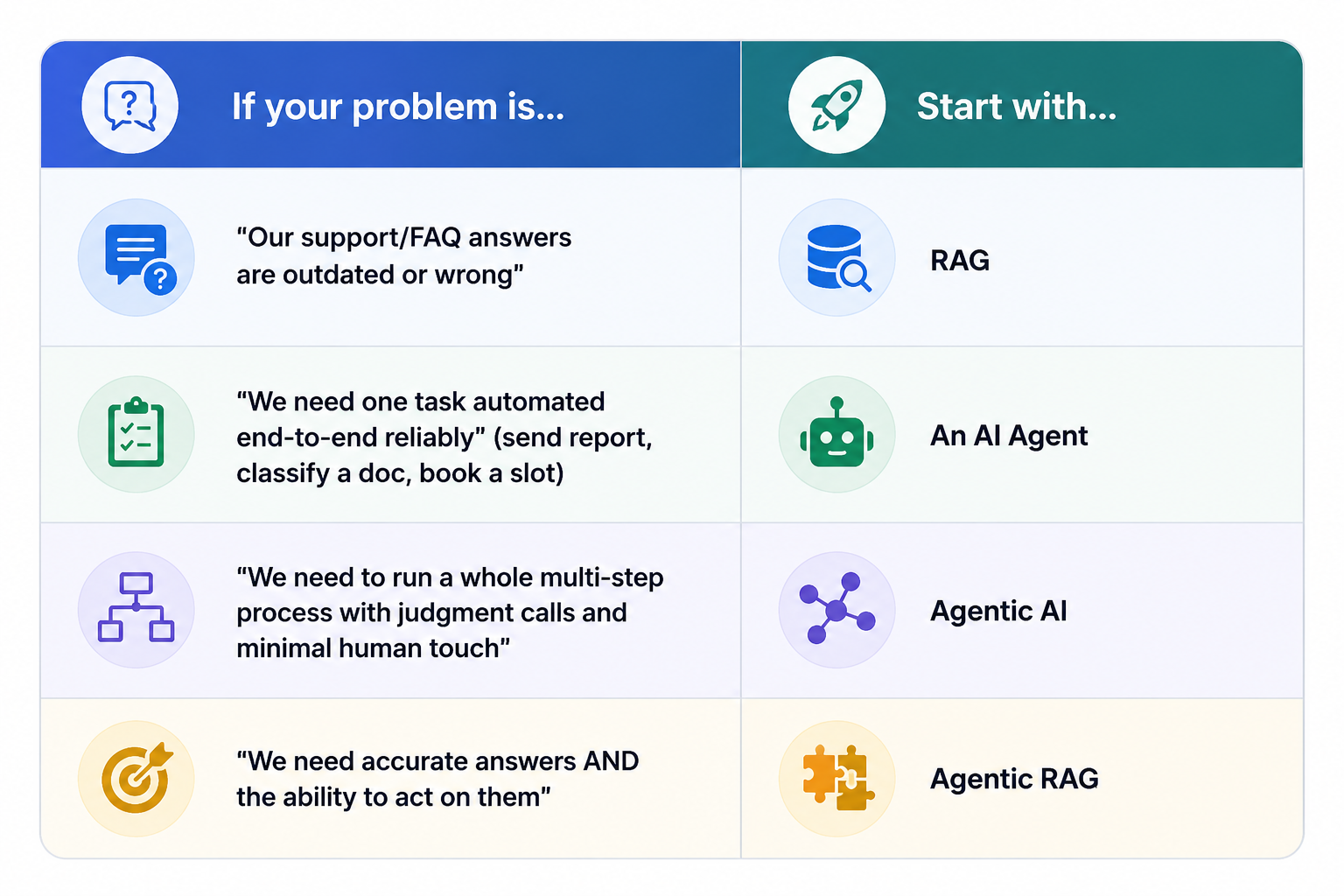
Three questions worth answering before committing to a build:
- Do you primarily need to surface correct information, or actually execute actions across systems?
- How much unsupervised autonomy can your operations realistically tolerate — legally, financially, reputationally?
- Can you trace and audit a failure if the system does something wrong? (If not, you're not ready for the agentic tier yet.)
Conclusion
RAG, AI Agents, and Agentic AI aren't competing technologies — they solve different problems. RAG helps AI deliver accurate, grounded answers. AI Agents go a step further by completing specific tasks with the help of tools. Agentic AI brings multiple agents together to plan, adapt, and achieve larger goals with minimal human input. Understanding these differences helps you choose the right approach, avoid hype, and invest in AI that genuinely fits your business needs.
FAQs
Is an AI agent the same as agentic AI?
No. An AI agent is a single software entity that completes a defined task using reasoning and available tools. Agentic AI is the broader system — often made up of multiple AI agents working together toward a larger, multi-step goal with greater autonomy, planning, and self-correction.
Does RAG count as "agentic"?
Not by itself. Traditional RAG follows a fixed retrieve-then-generate workflow and doesn't decide whether to search again, call external tools, or change its plan. It becomes agentic only when an autonomous AI agent controls when and how retrieval happens — an approach often called Agentic RAG.
Which approach is best for reducing AI hallucinations?
RAG is generally the strongest choice for minimizing hallucinations because it grounds responses in retrieved, verifiable information instead of relying only on the model's internal knowledge. AI agents and agentic AI can also benefit from RAG, but their added autonomy introduces different risks, such as incorrect tool selection or flawed planning.
Is agentic AI just marketing hype?
Not entirely. While terms like agentic AI are sometimes overused — a practice Gartner refers to as "agent washing" — the underlying concept is real. Properly designed agentic systems can plan, use tools, adapt to changing conditions, and complete complex workflows with far less human intervention than traditional AI applications.
When should you use RAG instead of an AI agent?
Choose RAG when your priority is answering questions accurately from trusted documents, knowledge bases, or enterprise data. If the goal is to complete tasks — such as booking appointments, sending emails, or interacting with APIs — an AI agent is usually the better fit.
Can RAG and AI agents work together?
Yes. In many production systems, they complement each other. RAG supplies reliable, up-to-date information, while the AI agent decides when to retrieve data, which tools to use, and what actions to take. This combination is often referred to as Agentic RAG and is becoming a common architecture for enterprise AI applications.
Blogs and Articles
Read Euro American Institute blogs on education, culture, and innovation.

 17Sep
17SepEducation
Zero Trust Security: A Practical Guide for Beginners
Zero Trust Security is a modern cybersecurity framework that requires strict identity verification for every user and device. Based on the principle “never trust, always verify,” it protects networks, data, and systems through continuous monitoring, least privilege access, and advanced authentication methods. This guide explains its principles, architecture, and real-world applications across industries.
Read More
 28Aug
28AugEducation
Top 10 Toughest Exams in the World : 2026 Edition
The pursuit of academic and professional excellence today is defined by the challenge of overcoming some of the world’s most demanding examinations. Spanning disciplines such as engineering, medicine, finance, and networking, these tests are not merely evaluations of knowledge but rigorous trials of endurance, strategic thinking, and mental resilience. With evolving formats, fierce competition, and high stakes, they shape career trajectories and open doors to elite institutions and prestigious roles. This article explores the top 10 toughest exams globally, highlighting their structure, unique challenges, and preparation strategies, based on the latest data and trends.
Read More