

Theory X and Theory Y Leadership Framework: A Deeper Analysis
Theory X and Theory Y Leadership Framework: A Deeper Analysis
Most corporate workforce ecosystems still favour the imposition of hierarchical authority, grounded in the assumptions of classical theorists like Frederik Winslow Taylor and Henri Fayol.
Interestingly, those autocratic views of the classical theorists align with what Douglas McGregor conceptualised in Theory X, a somewhat pejorative management style proposing that employees must be subjected to closer supervision and immediate punishment.
A brief detail about Douglas McGregor and his contribution
An influential American social psychologist and MIT management professor, Douglas Murray McGregor (1906-1914), unearthed the organisational behaviour by conceptualising the principles of Theory X and Theory Y in his 1960 book, "The Human Side of Enterprise".
In the book, he talked at length about managerial assumptions. He challenged conventional, authoritarian corporate management and sided with a more humane, trust-based approach to employee motivation and leadership.
In simple words, he theorised that how managers perceive their employees determines their leadership, which then contributes to influencing the overall organisational culture. McGregor has been instrumental in proposing the model of workforce motivation and productivity enhancement.
An explanatory Note to the Theory X and Theory Y Leadership Framework
Theory X: Put employees under pressure, and they will perform better
Theory X is a negatively charged assumption towards the workforce. It reflects an autocratic style of leadership and control, assuming that workers are lazy, not ambitious, and that they work only for a sustainable income. Theory X leaders hold onto the belief that employees perform better when subjected to a hands-on approach, supervision, and intimidation.
Theory Y: Employees do not need pressure to perform; they do so on their own
Unlike Theory X, Theory Y leadership is not a pejorative depiction of the typical workforce. For example, Theory Y management style assumes that workers are self-motivated, valuable resources to the company, and they enjoy their jobs, and perform better without expecting a reward in return.
This leadership theory maintains a semblance of democracy in the workplace, allowing employee productivity to bloom.
Critical analysis of Theory X and Theory Y leadership frameworks
Douglas McGregor's Theory X and Theory Y frameworks are two contrasting assumptions on the management style of working. While the Theory X framework represents condescending managerial working style, the other one is rather supportive, lenient, and a building block of workforce productivity.
Critical Analysis:
- Douglas McGregor's theories of leadership framework are seen as an oversimplification of complex human behaviours. Classifying them into two distinct behavioural patterns is unwise.
- The theories lack universal appeal, as effective managers do not rely on either behavioural theory. Based on situations, they blend both approaches, according to the skill level of employees, the complexity of the tasks, and the company culture.
- The theories seem to be heavily influenced by Western industrial perspectives. Therefore, they may not dovetail properly with the cultural contexts of other countries.
- Theory X might be useful during a crisis situation, while Theory X might be appropriate for mature employees.
Explaining McGregor's Assumptions about Human Nature
Theory X and Theory Y represent McGregor's assumptions about human nature in contrasting ways. No doubt, Theory X holds negative views on the management style of working with employees. For example, it theorises that employees are inherently lazy and can avoid work whenever possible. In another assumption of the theory, employees must be disciplined to achieve target goals.
On the other hand, Theory Y proposes positive views of management working style with employees, saying goal-committed employees do not need direction or control, and they are creative in solving organisational problems.
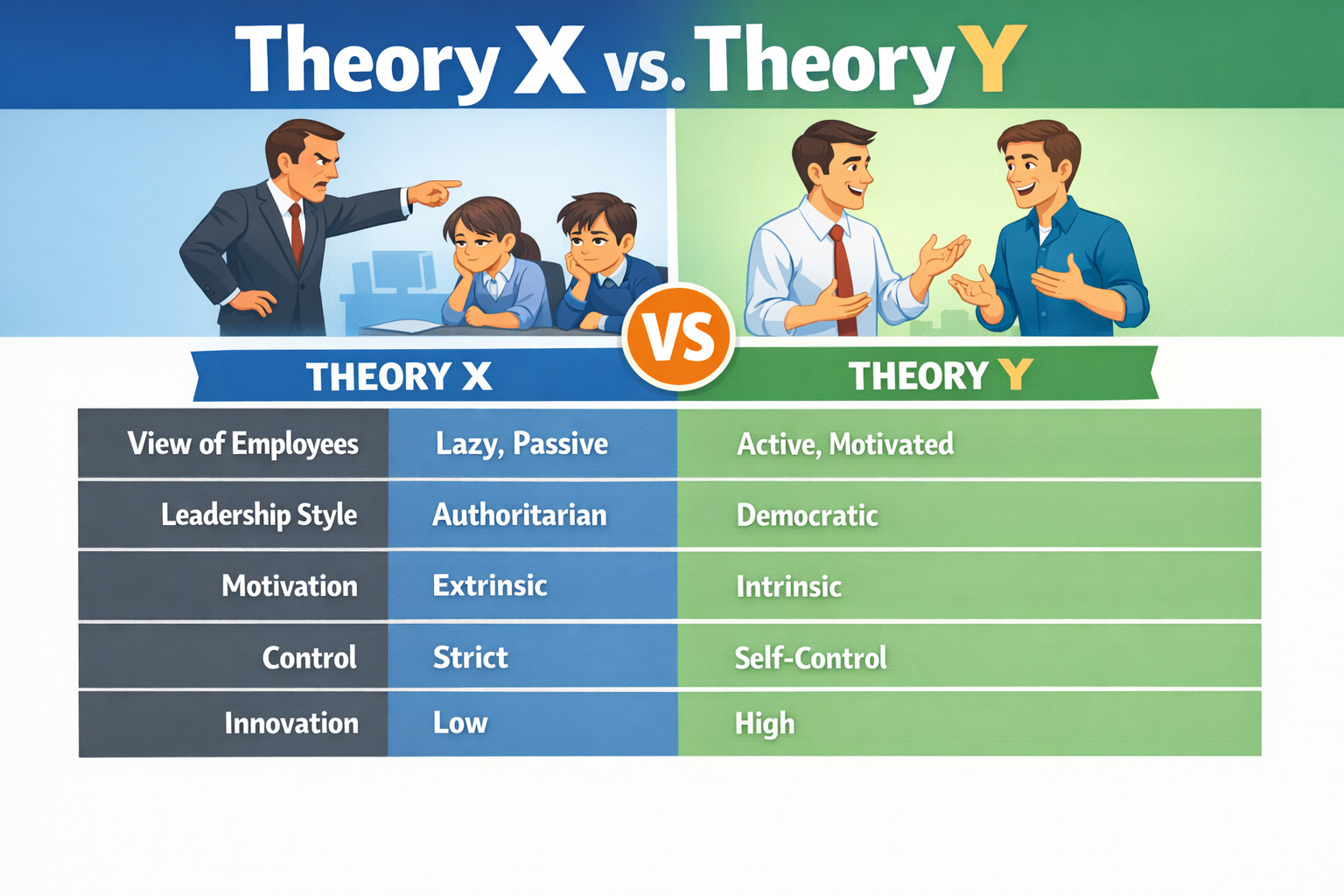
According to McGregor, human nature is not permanent; it is based on how people are treated. And in the workplace, human nature is subject to assumptions. For example, if Theory X managers impose micromanagement on the workplace, there is a higher chance that employees will feel demotivated and avoid work. On the other hand, Theory Y managers will treat employees positively.
McGregor theorises that what we see as human nature is often a reaction to the management style in practice.
Basically, McGregor believed that human nature at the workplace is subject to the interpretation of managers. While he personally believed that Theory Y was an accurate depiction of human nature, he argued that many managers were trapped in Theory X interpretation, which essentially is the cause of stifling human nature rather than making it a point.
Importance of McGregor's Theories of Leadership Framework in Modern Organisational Psychology
Modern organisational psychology welcomes McGregor's theories of leadership framework as a foundational stone for how management assumptions give direction to employee motivation and performance. While Theory Y lays the solid groundwork for driving high engagement and motivation, Theory X, on the other hand, brings forward key structures in regulated environments, accentuating that effective leadership is all about maintaining situational balancing.
One of the psychological aspects of these theories is that employees are created according to the expectations of managers. For example, Theory X leaders are likely to create demotivated employees putting in low-effort work.
Core assumptions of Theory X:
Key Assumptions:
- Employees do not like to work by nature.
- They lack ambition and abdicate responsibility.
- They need close supervision and strict control.
- They are only motivated when given a reward or punished.
Leadership Style:
- Theory X commands an autocratic, control-oriented management style.
- It favours centralised decision-making and top-down communication.
- Maintains clearly defined and rigid chains of command.
- Mandates rules and compliance with the fear of consequences upon non-observance.
Workplace Feature:
- Imposes a strict hierarchical structure, ensuring managers control subordinates.
- Employees are closely monitored, coerced, and threatened with punishment to fulfil the goals.
- Employees have almost no authority over their tasks or decision-making.
- A workplace that mandates Theory X is usually averse to change. It generally sticks to traditional methods.
Strengths:
- Acceptable in low-skill workplace environments.
- Commands higher productivity in structured environments, such as handling routine or repetitive tasks.
- Employees have clarity about their tasks due to the top down communication approach.
- Useful in observing compliance with safety protocols and strict regulations.
Criticism:
- Induces resistance and disagreement
- Stifles growth and innovation
How McGregor's Theories Shape Leadership Behaviour
McGregor's Theory X and Theory Y give a new perspective on leadership behaviour by encouraging managers to weigh in their basic assumptions about human motivation. While Theory X adopts an autocratic leadership style based on the assumption that employees are work-averse and should be disciplined to achieve goals, Theory Y maintains a friendly, positive attitude based on the assumption that employees are self-driven and goal-centric.
In this context, Theory X leaders represent the aura of micro-managers imposing an authoritarian style of working tied to close supervision of workers. Theory Y leaders represent those managers implementing a supportive environment and allowing employees to take ownership of their tasks. Though the Theory Y leadership framework is appropriate in the modern workforce ecosystem, most managers favour a hybrid approach like adopting Theory X as well, depending on the situation.
Efficacy of Theory X and Theory Y According to Research
- Productivity - As far as productivity improvement at the workplace is concerned, Theory Y is an absolute winner. Research by Oxford University's Said Business School, in collaboration with British Telecom, has found that when workers are happy, they are 13% more productive.
- Innovation - Companies that allow practice of Theory Y approaches are reportedly getting more new project initiatives, which are 25% higher rates. A reason supporting this outcome is attributed to Theory Y favouring psychological safety of employees, something that any risk-taking initiative demands.
Are Theory X and Theory Y leadership frameworks still relevant in the modern era?
Even though the concept of McGregor's theories of leadership framework was introduced in 1960, it is still a guiding book to understand leadership style and employee motivation.
Granted that Theory Y is ideal in a modern, creative workplace, effective leaders are no longer prioritizing specific frameworks. They, in fact, prioritise both frameworks by blending them together based on situational requirements.
- The transition toward remote work has made the Theory Y leadership framework more trustworthy by ruling out traditional methods of close supervision of employees, thus proving that work autonomy drives productivity.
- The modern workforce ecosystem doesn't have much room for a Theory X-centric management working style. In fact, a purely authoritarian working system like Theory X doesn't induce motivation, something that the modern system of working needs.
- The Theory Y leadership framework is undoubtedly good for creative and skill-demanding environments; Theory X is still relevant in the environments mandating effective crisis management and rigid compliance.
Conclusion
McGregor's Theory X and Theory Y leadership framework gives a broader understanding about how assumptions-based treatment to employees shape leadership quality of managers and then the organisational culture in the long run.
Both theories present contrasting views on the workforce ecosystem.
However, even in their opposing viewpoints, the relevance of these leadership frameworks has broader application areas. For example, Theory X can find its application in areas such as the military, manufacturing, and crisis management. On the other hand, Theory Y thrives in areas like creativity, skill-oriented environments, and tech companies.
Lastly, McGregor's theories of the leadership framework can't necessarily be said to be a universal reality. That's because management styles in different organisations use these theories based on situational requirements, serving the business goals effectively.
Blogs and Articles
Read Euro American Institute blogs on education, culture, and innovation.
 28Aug
28AugEducation
Top 10 Toughest Exams in the World : 2026 Edition
The pursuit of academic and professional excellence today is defined by the challenge of overcoming some of the world’s most demanding examinations. Spanning disciplines such as engineering, medicine, finance, and networking, these tests are not merely evaluations of knowledge but rigorous trials of endurance, strategic thinking, and mental resilience. With evolving formats, fierce competition, and high stakes, they shape career trajectories and open doors to elite institutions and prestigious roles. This article explores the top 10 toughest exams globally, highlighting their structure, unique challenges, and preparation strategies, based on the latest data and trends.
Read More